This article is part of our new series, The People of Leros, where we highlight individuals either from the island or who have chosen Leros as a special home. Each person stands out through their unique story, passions, and the meaningful ways they enrich the community.
Today we get to know Nikos Kafentzis, a historical researcher with a deep passion for Leros and its modern history. Born in Athens and raised in Pyrgos, Ilia, he studied at the School of Pedagogical and Technological Education, in the Department of Mechanical Education, and worked mainly in the field of civil aviation. He has dedicated more than 25 years to studying historical events such as the Italian occupation and the Battle of Leros, gathering a rich unpublished archive and contributing to significant historical studies. A traveler, mountaineer, and collector of historical artifacts, Nikos is now permanently settled on the island, bringing to light aspects of the past that connect the island’s rich history with contemporary life.
What or who made you fall in love with Leros and dedicate yourself to its history?
The first person who instilled in me the love and passion for studying the modern history of Leros was my grandfather, Georgios (Giorgis) Valsamis, the first Mayor of Leros after the incorporation of the Dodecanese into Greece. At the same time, philologist and historian Manolis Isychos played a decisive role in my involvement with the island’s history. Finally, the person who shaped my course and helped me both materially and morally in creating and documenting my collection was Giannis Paraponaris and the entire Paraponaris family. Today, parts of my collection are exhibited at the Deposito Di Guerra – War Material Storage, run by the Paraponaris family.
"My most memorable discovery is inevitably the first remarkable object I found, at the age of 14: an Italian bayonet, stuck vertically into the ground...it reminds me of my childhood and the sense of romantic curiosity with which I began collecting."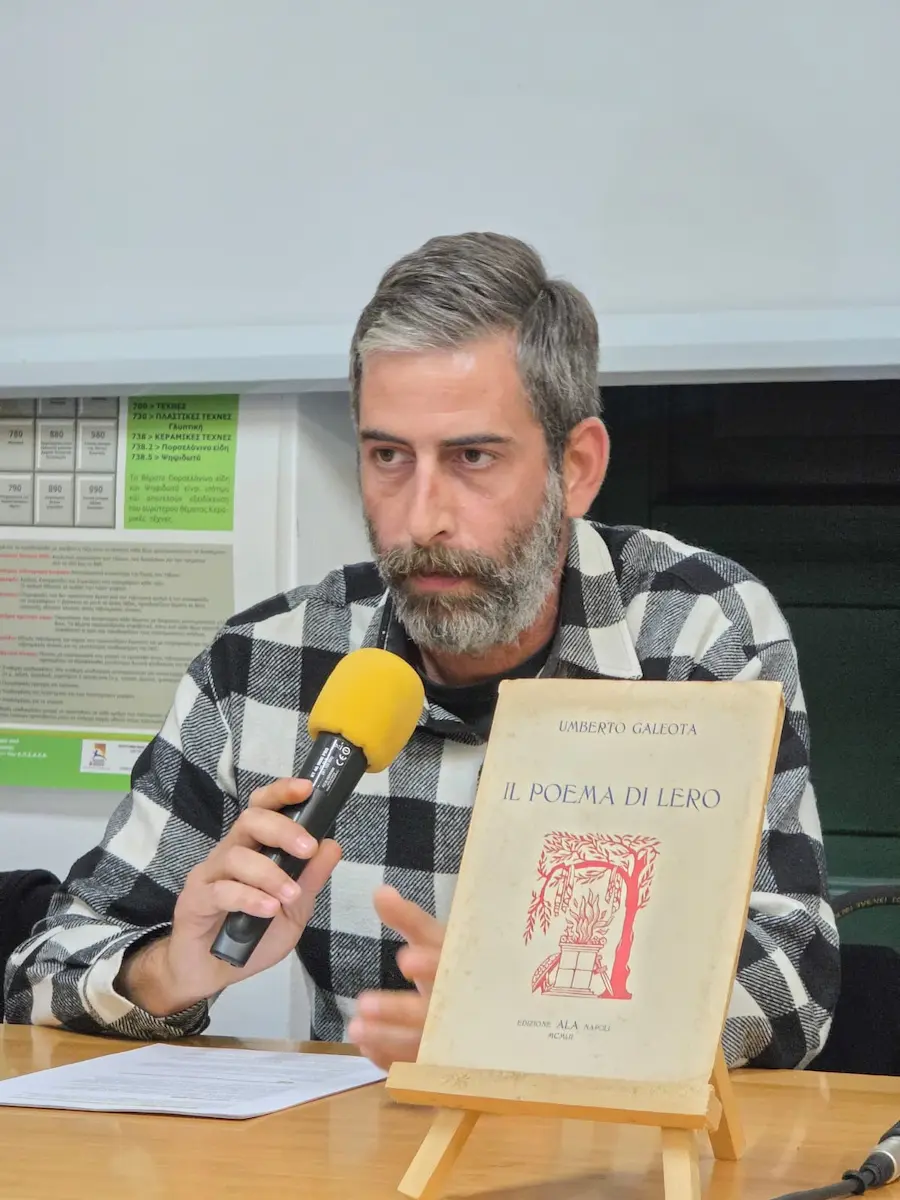
What kind of historical objects or testimonies impress you the most, and why?
For me, the most valuable items are the personal belongings, accounts, and stories of the people who served or fought on Leros. In my collection, I have more than 3,000 files of Italians who passed through the island, over 2,500 files of British soldiers, and more than 1,100 German files related to the Battle of Leros. Among them are unpublished photographs, documents, and personal items. The main goal of my research is to create a network of relatives and descendants of all these individuals, who, through actions and commemorative events, can exchange knowledge and information, keeping historical memory alive.
What has been your most memorable historical discovery on Leros?
My most memorable, though not necessarily the most important, discovery is inevitably the first remarkable object I found on Leros at the age of 14. It was an Italian bayonet, stuck vertically into the ground on the road leading to the War Museum – Tunnel in Merikia. While riding my bicycle, I noticed a sharp piece of metal protruding from the soil. Thinking I should remove it so no other child would get hurt, I began to dig it out and very quickly realized what I had found. To this day, it remains a special piece in my collection, reminding me of my childhood and the sense of romantic curiosity with which I began collecting items related to the island’s military history.
However, I consider far more important the ongoing effort of mine and a group of Greek and foreign historians and researchers to identify the locations and circumstances of death of those soldiers (Italian, British, and German) who still remain “unknown” in archives and military cemeteries.
What is your favorite historical site or building that you frequently visit on the island?
My favorite historical site on Leros is Merovigli, which served as the headquarters of the British during the Battle of Leros, and where the island was ultimately surrendered to the Germans. I also value Klidi and the northern part of the island in general, where most of the initial German landing operations took place.
As for buildings, the one I visit most often, and which is particularly meaningful to me, is the Paraponaris family museum, “Deposito Di Guerra – War Material Storage,” where the island’s military history is concentrated, expertly preserved, and properly presented.
Which historical events or oral traditions of Leros do you believe every visitor should know?
Inevitably, every visitor to the island senses that Leros carries a heavy and “dark” legacy, primarily of military character. I believe the events that must be highlighted for all visitors include the Italian fortification of Leros (1920s–1930s), the events of the Battle of Leros (September–November 1943), and the period of the Leros State Psychiatric Hospital, as this last one answers the question almost every visitor asks: “Why are all these buildings abandoned, and why doesn’t the local community make use of them?”
What brings you the greatest satisfaction in your work?
Perhaps the greatest satisfaction I gain from my continuous engagement with researching, documenting, and preserving the island’s modern history is that people interested in it, but without access to information, are finally able to learn.
I also consider the creation of a broad network of relatives and descendants of the protagonists of the island’s historical events, mainly through social media, one of my most important contributions. Additionally, I find tremendous value in the constant new knowledge emerging from both bibliography and field research, which I carry out alongside a team of Greek and foreign historians and researchers on the island’s wartime events.
Finally, I feel deep moral satisfaction when informing and raising awareness among the younger generation of Leros, to whom I try, through personal and collective actions, to instill a healthy mindset about protecting the island’s tangible and intangible heritage.
"What I love most about the island, and the reasons I recently moved here despite the limitations and practical challenges, are the quality of life, the availability of people, and the time."
How do you think the residents and visitors of Leros can benefit from the island’s history?
For this to happen, a change in mindset is needed, one that may require a generational shift. Time is running out, especially regarding the island’s buildings, which are being neglected, vandalized, and collapsing day by day.
If the island reaches this change in mindset, I believe that through developing a serious, long-term strategy focused on the principles of historical tourism and memory tourism, and by involving the right, qualified people, there can be enormous benefits. After all, there are many examples of communities that thrive by embracing their historical uniqueness, and Leros has exceptional potential in this direction.
If I had to summarise it in three points: “Pressure from local institutions upwards – the right people in the right positions – a shift away from opportunistic and short-term thinking.”
What do you love most about life on the island?
As someone who lived the last 20 years in Athens and abroad, what I love most about the island, and the reasons I recently moved here despite the limitations and practical challenges, are the quality of life, the availability of people, and the time. I also have the opportunity to deepen my research into the historical events I have studied for the past 25 years.
What are your plans for the future, both personally and regarding your professional or cultural work?
I prefer not to answer that with words, but with actions. However, my work will certainly continue through the “Deposito Di Guerra – War Material Storage” museum of the Paraponaris family, as I believe my philosophy aligns entirely with the museum’s mission and goals.
Nikos Kafentzis is not just a history researcher. He is deeply connected to Leros, not only as the subject of his work but as a personal commitment. Through long-term study, meticulous documentation, and a generous willingness to share his knowledge with both locals and visitors, he has made a remarkable contribution to preserving and illuminating the island’s historical memory. His work reminds us how powerful individual dedication can be when it grows into actions that serve an entire community.
And for all of this, we thank him.