





This article is part of our new series, The People of Leros, where we highlight individuals either from the island or who have chosen Leros as a special home. Each person stands out through their unique story, passions, and the meaningful ways they enrich the community.
In this article we meet the painter, Michael Winters, born in 1943 in Australia and trained at the Caulfield Institute of Technology from 1959. He first arrived in Greece -and on Leros- at the formative age of twenty-two. That encounter marked the beginning of a lifelong relationship with the island, shaping both his artistic vision and personal identity. Over six decades, Winters has returned to Leros again and again, creating murals, prints, and paintings inspired by its landscapes and people, teaching locals, and forging deep bonds within the community. We interview him to explore this remarkable life story: how a young Australian artist found his spiritual and creative home on a small Dodecanese island, and how Leros, in turn, became part of his legacy.
Can you tell us about your first visit to Leros? What drew you to the island?
I studied at art school in Australia, where my history-of-art lecturer spoke passionately about archaic Greece – its philosophy and art. His enthusiasm captivated me, and he urged me to visit the country. In 1965, I left Australia on Patris* to discover Greece and its ancient history. During the journey, I met a Greek man returning from Melbourne, Antonis Tsaloumas. When he realised I had no plans in Athens, he said, “Come to my island. I’ll help you.” That island was Leros.
Antonis met me upon my arrival on a rainy day at the port of Lakki and arranged a room for me at Hotel Leros*, then found a house for me in Platanos. That was the beginning of my relationship with the island. Before we parted on the ship, he told me to meet his brother, the poet Dimitris Tsaloumas*, when I returned to Australia. I did so years later, in 1975. Dimitris asked me to illustrate his poems, and some of my paintings of Leros ended up on the covers of his books. One of those books, The Observatory, won the 1984 Book of the Year Award in Australia.
Meeting the Tsaloumas brothers shaped the direction of my life and my connection with Leros.

What originally captivated you about Leros?
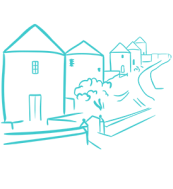
What struck me first was the island’s topography: the way Platanos and Agia Marina sit along the hillside, with houses clustered as if part of a theatre set. People seemed to move in and out of doorways like actors on a stage. Above everything, the castle presided over the village. I often climbed up at night to sit there, reflecting on the layers of history – from the Crusades to more recent times.
In those early years, I experienced remarkable hospitality. There were donkeys everywhere and a pace of life that has since disappeared with modernity and the arrival of cars.
How do you feel about the changes you see today?
Change can bring good and bad. The increase in traffic has made the streets far less peaceful and sometimes dangerous. When I first came, there were perhaps six cars and around 2,000 donkeys. Now the reverse is true.
Life has also become far more expensive. Even simple outings require more planning. I notice a shift in everyday interactions too: in earlier years, people greeted me warmly “Yassou, Michali! Pali edo? – Hi, Michali! Here again?” Now, service is more rushed, less personal.
Many of my old friends have passed away, and that brings its own sadness. But Leros remains deeply meaningful to me. One of my children was born here in 1984; although he sadly passed away at the age of 34, I’m proud to say that I had a Leriot in my family. All three of my children have Greek names – Christophoros Antonis, Zoe Elefteria, and Thomas Andreas – a reflection of the island’s place in our family story.
Are there works of yours that capture the spirit of Leros?
Two murals stand out.
In 1979, I created a mural for Apostolos Evangelou & Fanis Miniotis, the owners of Diana Disco* in Panteli. It no longer exists, but it was my first large piece on the island.
"Something awakens here that does not happen in Australia - an atmosphere, a spirit, a sense of theatre in everyday life." 
In 1983, I painted Life on Leros for a restaurant in Panteli. The restaurant closed, and the mural remained untouched for 43 years. Recently, during a children’s art class, from Artemis, Aggeliki, their art teacher, gave photocopies of the mural to the students, who responded to its scenes – bakers, fishermen, motorcyclists doing kamaki, small churches. Watching them draw their interpretations was deeply moving.

"The other day I saw a fisherman in Agia Marina... He was smoking with some cats surrounding him. Everything seemed quite theatrical, to me in a strange way, so I did a drawing of him." I also taught printmaking on Leros for two years beginning in 2007, working in a studio on the ground floor of Michalis Boulafentis*’ house. I have brought entire painting groups from Australia, so others could experience and respond to the island. It was something new for the island and an extraordinary experience for me.
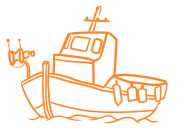
Even now, every time I return, I continue drawing. Something awakens here that does not happen in Australia – an atmosphere, a spirit, a sense of theatre in everyday life. The other day I saw a fisherman down in Agia Marina, looking sad, or so I thought. He was smoking with some cats surrounding him. Everything seemed quite theatrical, to me in a strange way, so I did a drawing of him. It’s a fantasy drawing of that man, of what he’s thinking.
Also, the other thing I’ve done here, is that I’ve done sets for the Theatrical Group of Leros. To do a set in the land of theatre, Greece, as an Australian… What an experience!
You were named an honorary citizen of Leros in 1995. What did that recognition mean to you?
It meant a great deal. I was not simply visiting for holidays; I was trying to understand the island and express it through my art. One day, in 1995, while having coffee in Agia Marina, the mayor, Antartis*, joined us. When he learned I had first arrived in 1965, he said, “Really? When you return, we’ll make you an honorary citizen.” I was deeply touched by that.
A small ceremony followed in the mayor’s office, and I received the certificate, which I still have and is very special to me. From that time on, people began greeting me as “o Michalis mas – our Michael!” It added another dimension to my relationship with Leros and validated my artistic work here.
Exhibitions of my Leros paintings in Australia have allowed audiences there to discover the island. Once, a technician in Melbourne, born on Leros, recognised one of my linocuts hanging on a wall and said, “That’s Leros!” Moments like that are precious.
How do people, all over the world, respond to your work?
People often tell me my work reflects the idea of “ta panta rei” – that everything moves and changes. Even when the forms appear solid, there is a sense of transformation. I try to express not only the physical landscape but the spirit of the place, and that resonates with viewers in different ways depending on where they encounter the work.
Also, during one of my exhibitions, in 1983, people would tell me: “Michali, you’re really looking at our island. It’s not just pretty pictures, you’re looking at who we are and what we’re doing.”

As a mentor, what advice do you offer young artists?
Paint where you live. Notice the everyday: a cat in the doorway, the sea outside the window, a song from a neighbour, a bouzouki night, the island’s dancers and music. Don’t just describe it, but show how it feels. Let your topos – your place – express itself through you: its history, architecture, mythology, folk songs and voices. Even in a modern age of mobile phones and technology, the ancient beauty of Leros remains, waiting to be seen and reinterpreted.
Do you see new artistic talent emerging on Leros? How could the island better support the arts?
Leros needs a dedicated municipal gallery where the island’s artistic legacy can be preserved and displayed permanently. The island has a long history of painters -Greek, Australian, English. My own 29 linocuts will remain here forever, which means a great deal to me.
There are also unused buildings, such as old Italian structures or even neglected kiosks (periptera), that could host summer schools, exhibitions, or small creative shops. Other islands, like Skyros, have developed strong artistic and educational programs that attract international visitors.
Simple initiatives could enrich cultural life: murals in restaurants, original art on walls, or artistic postcards for visitors to take home – authentic visual stories of the island.
A message to Leros and its people: what would you wish for the island’s future?
Tourism is both a blessing and a challenge. The cost of living and heavy traffic affect the quality of life. These problems are difficult to solve, but the spirit of the island must somehow be protected.
I would like to see cultural spaces open year-round, places where residents and visitors can gather, learn, discuss, and engage with the island’s stories. Not just beaches and food, but creative opportunities that offer a deeper experience of Leros. Art can play a powerful role in preserving identity. Even small actions, like a mural, a gallery, or a thoughtful postcard, can help the island express itself to the world.
Is there anything you would like to add?
I’m glad to see new voices emerging on Leros – people who understand the island from different angles and contribute creatively. If my work allows others to see Leros in a new way, then I feel fortunate. My eyes came from far away, but they recognised here something ancient, beautiful and alive.
After more than six decades of visiting, creating, and teaching on Leros, Michael Winters’ connection to the island transcends that of a mere visitor. Through his murals, linocuts, and paintings, he has captured the spirit of the landscape and its people, while his mentorship has nurtured new generations of artists. Winters’ reflections remind us that Leros is more than a picturesque destination. It is a living, breathing cultural and creative community. His hope for the island’s future, for spaces that celebrate and preserve its artistic identity, leaves a lasting message: that Leros, while evolving, should continue to honor its history, its people, and its unique spirit.
Footnotes
*Patris: a Greek passenger liner operated by Chandris Line – originally built in 1950 as the Bloemfontein Castle – that made 91 voyages between Greece and Australia (1959 – 1975) carrying hundreds of emigrants and playing a key role in post-war migration.
*Hotel Leros: also known during the Italian period as Albergo Roma, was originally built in 1938 in Lakki, Leros. Today, it is being restored.
*Dimitris Tsaloumas (1921–2016): a Leros-born Greek-Australian poet whose bilingual work bridged Greece and the diaspora, earning major recognition such as Australia’s National Book Award for The Observatory.
*Diana: The iconic Disco in Panteli founded in 1979. Currently operating as a Club under a different name.
*Giannis Antartis: (1944, Astypalaia) long based in Leros, is a civil engineer and community leader who served three terms as mayor and has held numerous presidencies in local cultural, social, and sports organizations.