








This article is part of our series, “The People of Leros”, where we highlight individuals either from the island or who have chosen Leros as a special home. Each person stands out through their unique story, passions, and the meaningful ways they enrich the community.
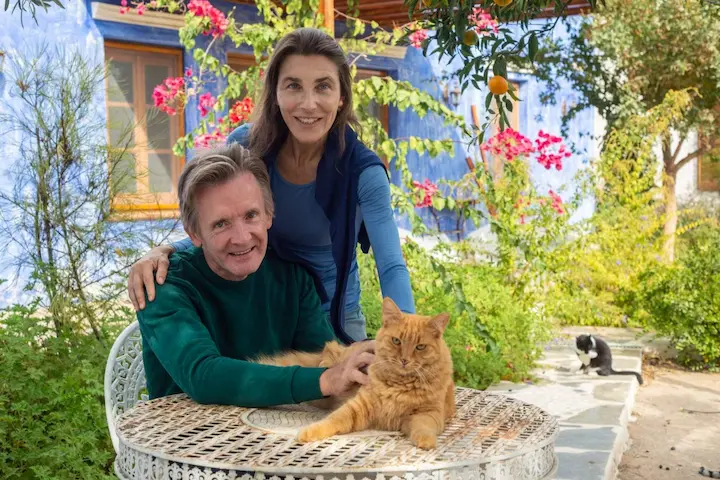
Many of you already know her, even if you do not know her story. You have seen her at feeding stations in Agia Marina, Platanos or Laki, quietly making her rounds, caring for the island’s stray cats. Isabelle Manevy arrived on Leros in 2019 after a simple newspaper article about its neoclassical houses caught her attention. What began as a visit from London, where she worked as an executive coach, soon became a permanent move and an unexpected life commitment. Today, through the Leros Cat Foundation, her home functions as a refuge for dozens of cats, she oversees nearly 30 feeding stations across the island, and she supports local families through employment. We spoke with Isabelle about how Leros changed her life and how, in turn, she has become part of the island’s everyday fabric.
What first brought you to Leros, and how did you decide to settle permanently on the island?
It all began with an article in The Guardian. My partner David saw photos of Leros’ beautiful neoclassical houses, and we immediately fell in love with the idea of visiting. Although we first planned a trip in 2018, work commitments delayed us until April 2019.
When we finally arrived, we visited several homes and eventually found a neoclassical house in Ammoudaries that felt perfect. The garden was full of mature orange, lemon, mandarin and olive trees, and everything was in bloom. It was fantastic!
We knew almost nothing about the island beforehand, yet within days we felt an instant attachment. That same year, we purchased our home and later returned in October to buy three additional properties in Agia Marina and Platanos.
What was your professional background before moving to Leros?
I worked as an executive coach, mainly supporting clients in the financial industry. David is a finance lawyer and continues to work, which is essential as the cats have now become a significant part of our lives.


"Caring for cats touches similar themes (with coaching): compassion, responsibility, and the fragility of life. Both roles, in very different ways, deal with the essence of what it means to care and to help."
Do you still work today?
Not professionally. Caring for the cats has become a full-time responsibility. If someone had told me years ago that I’d end up with dozens of cats at home and nearly 30 outdoor feeding stations, I would never have believed it. But here I am, fully immersed in this work.
How different is your life on Leros compared to your life before?
Completely different. Previously, I lived an urban, professional life centred around coaching, travel, and a structured schedule. Now my days revolve around animal care. We always loved cats and had adopted a few over the years, but after moving to Leros the number grew quickly, especially as more local animals needed help. The pace, mindset, and emotional landscape of my life have entirely changed.
Do you have a favourite place on the island?
Yes, a location near Merikia with panoramic views and a remarkable sense of calm. There is a large stone overlooking the landscape, and I find it deeply restorative. Friends I’ve brought there feel it too. Whether or not one believes in energy or “vortexes,” the peace of that spot is undeniable.
How do you experience everyday life on the island? What challenges or inspires you?
Island life is very different from city life, but Leros feels authentic, grounded, and genuine. That’s what I appreciate most.
While some limitations exist, especially compared to a big city like London, the internet now makes almost anything accessible. We have a cinema, community life, and a slower rhythm that I’ve come to embrace fully. Without realising, I said goodbye to the old life, and then I just plunged into this life, and this is what there is. I don’t feel nostalgia for my previous life; I live very much in the present and I don’t want this to change.
Do you miss anything from your previous profession?
Coaching was not about excitement but about listening deeply and helping people understand themselves. Seeing someone experience a breakthrough on not blaming themselves for something that happened to them, was incredibly meaningful.
Interestingly, caring for cats touches similar themes: compassion, responsibility, and the fragility of life. Both roles, in very different ways, deal with the essence of what it means to care and to help.
How did your dedication to caring for Leros’s stray cats begin?
It wasn’t a planned decision. It happened gradually. When David returned at the end of 2020, we had just a few cats. Then one more arrived, then another.
After we created a website, some people assumed we were a formal shelter and began leaving kittens at our door. One summer, 20 kittens were dropped off. With each case we felt responsible, and the numbers kept growing. That is how we eventually reached 54 cats in the house and around 25 in the garden.

"If someone had told me years ago that I’d end up with dozens of cats at home and nearly 30 outdoor feeding stations, I would never have believed it. But here I am, fully immersed in this work."
Do you receive help from volunteers or the municipality? How does collaboration work?
The municipality once asked how much food we needed, but we have not received further support since then. All expenses are covered privately, except for medical treatments funded through donations.
We manage about 29 to 30 feeding stations. I personally oversee six. We also provide jobs for people in need. We support three – four families: Effie, who is our employee, two more women, and Yanni, who manages feeding stations around Lakki.
Some residents and foreign supporters, like Katrina, Antonia, Danielle – really lovely people – but staffing is challenging because the island already faces labour shortages, especially in hospitality.
What are the biggest challenges in running such an operation?
The primary challenge is that we do not yet have a formal shelter. Our home effectively functions as one, and many other animal-loving households, like Sylvie’s, are already full.
Our dream is to buy land and build a proper, modern shelter where vulnerable cats can live safely long term. We are now exploring a European Union funding programme with the help of a supporter, Danielle. However, the programme requires us to contribute 30 percent of the funds, which is significant.
What would be the ideal development of your work over the next few years?
Our ideal future is to secure the 30 percent contribution, obtain EU funding, and build a state-of-the-art cat shelter on Leros. This would change everything, providing a stable, safe place for cats that cannot live outdoors and giving the island a landmark resource.
At the moment, our home has become a cat house. A dedicated shelter is essential for long-term sustainability.
Isabelle did not arrive on Leros with a plan to build a network of feeding stations or to turn her home into a refuge. It happened step by step, cat by cat, responsibility by responsibility. Today, her work reaches far beyond animal care. It supports local families, connects residents and visitors, and quietly strengthens the island’s sense of compassion and shared responsibility. In caring for the most vulnerable creatures among us, she reminds us what community truly looks like on Leros.
If you wish to donate or volunteer, you can find The Leros Cat Foundation on TikTok and on their website www.theleroscatfoundation.com