Among the well-known landmarks of Leros, there is a building which, despite bearing a profound historical and spiritual legacy, remains largely unknown to the wider public, as information about its past is not easily accessible. This is the “Patriarchate” of Leros: a building that deserves to be rediscovered, not only for its architectural presence, but above all for the history and the people who established it as a point of spiritual and cultural reference.
The Vision of Patriarch Sophronius
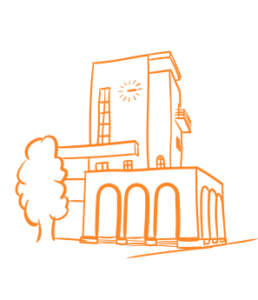
At the entrance of the bay of Alinda, the most renowned tourist area of Leros, stands a building of particular historical and spiritual significance: the so-called “Patriarchate of Leros.” It is a monument that connects the local history of the island with the broader ecclesiastical and cultural world of Hellenism.
The original building was erected around 1884 by Sophronius the Byzantine, former Ecumenical Patriarch and later Patriarch of Alexandria. Sophronius first visited Leros in 1882, remaining on the island for several months. This experience proved decisive, as he was captivated by the mild climate, the natural beauty, and the warm hospitality of the island’s inhabitants.
The Leros-born Grand Archivist of the Patriarchate of Alexandria, Theodoros D. Moschonas, records that the Patriarch developed a deep affection for Leros and decided to build a summer residence there, along with a chapel dedicated to Saint Sophronius, so that he could spend the summer months on the island. From that time until his death, he did not fail to visit Leros even once.
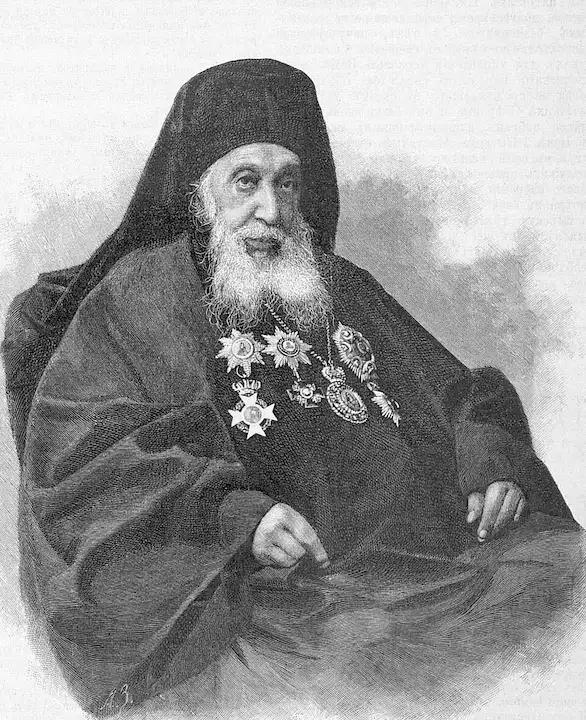
Patriarch of Alexandria Sophronius (1802-1899)
The Patriarch’s arrivals were festive events for the island. Church bells rang, residents gathered to receive his blessing, students chanted hymns, and in the evenings, at a time when public lighting did not exist, fires were lit on the surrounding hilltops or even within the bay of Alinda, creating a unique and evocative scene of welcome.
From Destruction to Renewal
After Sophronius’ death in 1899, the building passed into the ownership of the Holy Metropolis of Leros, as he had bequeathed it by will to the Holy Monastery of Panagia tou Kastrou. During the World War II it was heavily bombed and for many years remained in ruins and uninhabitable. Repair works were carried out in 1955; however, the structure was deemed structurally unsafe.
The substantial revival of the Patriarchate began in 1995, when it was included in the INTERREG II program with funding from the European Union, following the necessary approval of the Ecumenical Patriarchate and the competent state authorities. The old building was demolished and rebuilt from the foundations up, restoring its architectural dignity and creating a modern and functional space.
The "Patriarchate" of Leros in 1930
The "Patriarchate" of Leros in 1990
A Living Center of Spiritual and Cultural Life
The new building, named by the Ecumenical Patriarchate the “School of Sophia (Wisdom),” was inaugurated on 26 September 1999 by Ecumenical Patriarch Bartholomew, in the presence of the then Deputy Ministers of National Economy and Social Welfare. Since then, it has operated as a Center for Religious and Cultural Heritage and Development.
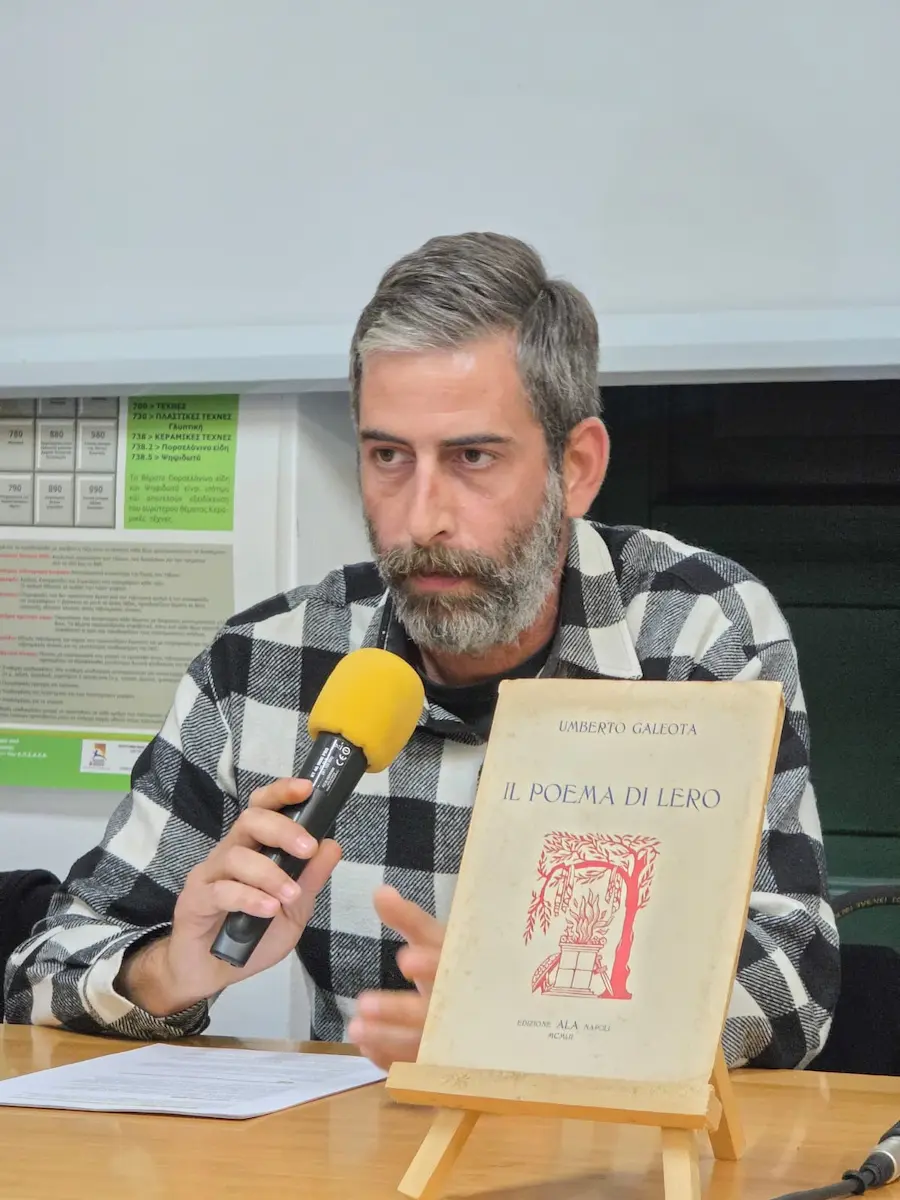
The main conference hall has the capacity to host between 100 and 150 seated participants and is equipped with modern technical infrastructure, air conditioning, and all the necessary facilities for international events. From 1999 to the present day, the Patriarchate of Leros has hosted international conferences, workshops, medical and educational seminars, meetings of representatives of Patriarchates and Autocephalous Churches, cultural events, book presentations, art and photography exhibitions, as well as major events of both local and international scope.
Main Hall
Conference Hall
Thanks to the ongoing spiritual guidance of the Ecumenical Patriarchate and the long-standing ecclesiastical tradition of the area, Leros has gained a symbolic space of exceptional significance. It is a true spiritual and cultural landmark in the Aegean, highlighting the island as a center of dialogue, memory, and creative exchange.
The Patriarchate of Leros is not merely a building. It is a living vessel of history and culture, contributing decisively to the spiritual and cultural outreach of Leros, both within and beyond Greece, and establishing the small, borderland, and long-suffering island as a point of reference of international standing.
We would like to extend our warm thanks to Mr. Georgios I. Chrysoulis, Secretary of the Holy Metropolis, who collected and shared the relevant information.