This article is part of our series, “The People of Leros”, where we highlight individuals either from the island or who have chosen Leros as a special home. Each person stands out through their unique story, passions, and the meaningful ways they enrich the community.
Born and raised on Leros, Michalis Kontrafouris chose to return to the island after completing his veterinary studies, despite opportunities elsewhere in Greece. What began as a professional decision gradually became a long-term commitment to serving the needs of small island communities.
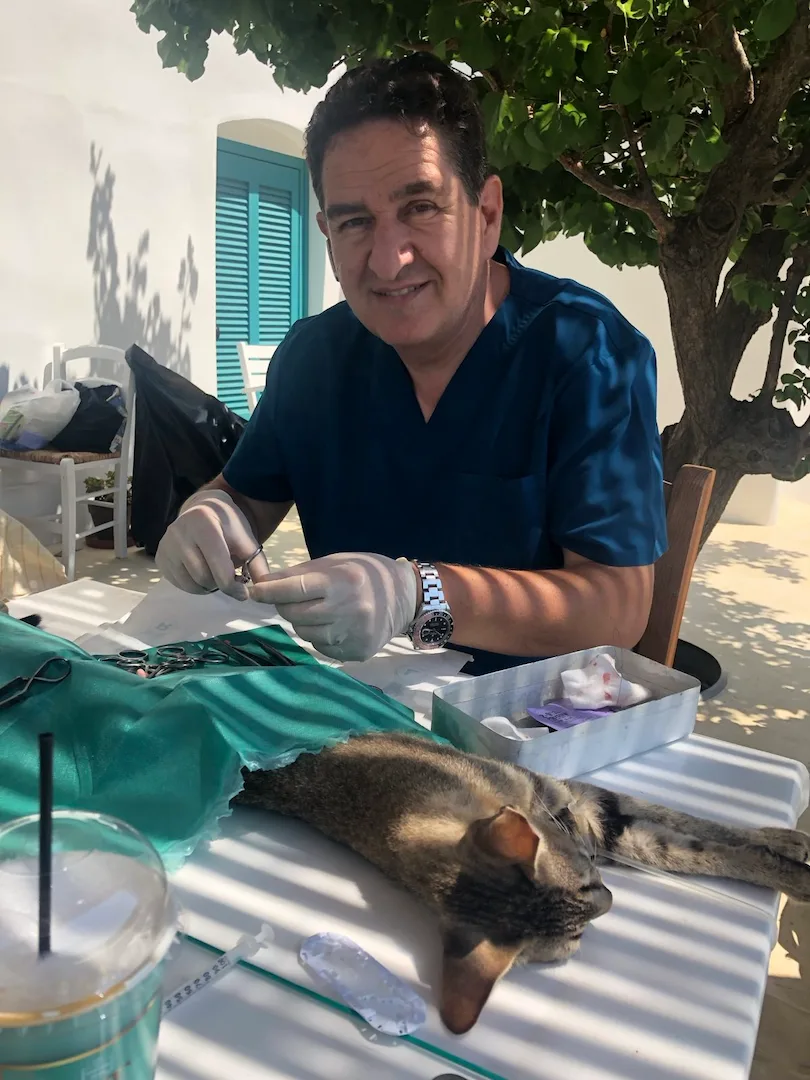
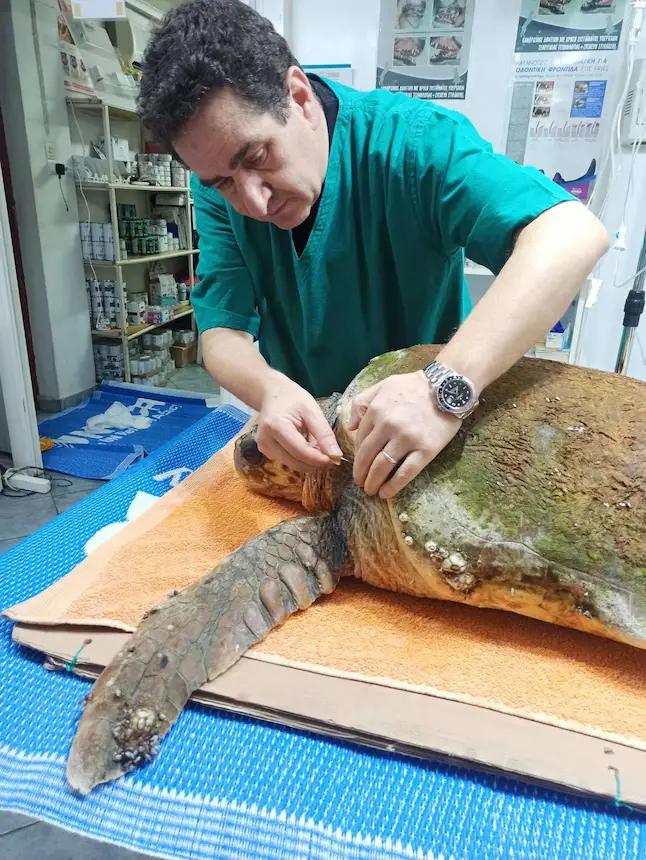
For many years, he has worked as a veterinarian across Leros and neighboring islands, covering everything from livestock and companion animals to wildlife and food safety inspections. At the same time, through his involvement in local government as Mayor and Deputy Mayor, he contributed to infrastructure projects and public services during a period of significant development for the island.
In this interview, he speaks about growing up on Leros, the challenges of working on remote islands, his experience in public office, and his hopes for the island’s future.
Could you tell us a few words about yourself?
I was born and raised on Leros. I attended the elementary school of Agia Marina and then the Belenio Gymnasium and Lyceum, from which I graduated after successfully gaining admission to the Veterinary School of Aristotle University of Thessaloniki. Compared to today, I can say that we grew up in the neighborhoods, living a carefree childhood with our games and our involvement in football, basketball, swimming, fishing, etc. Thankfully, we didn’t have mobile phones or the internet…
Why, after your studies, did you choose to return to Leros? What do you love most about the island?
I was fortunate enough to be admitted to a school and choose a profession that did not exist on my island or on the surrounding islands. This gave me the opportunity to become professionally active very early on, almost from my student years, and to work in veterinary medicine to the extent that my studies were financially supported by this work.
So, after earning my degree, despite the proposals I had either to continue with a PhD at the university or for collaborations in other parts of Greece such as Athens or Rhodes, the already “well-established” situation on the island led me to return and start my professional activity there.
The calmness and ease of the way of life, as well as my bonds with family, relatives, and friends, are what won me over.

"The greatest reward is the love and response from the people... who see you ... as a supporter who will help them with every problem."
Living and working on islands, what is the greatest challenge and the greatest reward for you?
Working on islands is difficult, and that’s why many scientific specialties hesitate to return and offer their services there.
The lack of basic infrastructure, mainly in Health, Education, and Transportation, makes everyday life challenging.
As far as my profession is concerned, the biggest challenge is that you are obliged to do everything:
Veterinary medicine and animal husbandry for production animals (cattle, sheep and goats, pigs, poultry, rabbits, bees, fish, etc.),
veterinary care for companion animals (dogs, cats, horses), and even wildlife, food hygiene and meat inspection controls through contracts with the Prefecture.
All this from Agathonisi to Kalymnos, and from Marathi and Arkoi to Astypalaia!
The greatest reward is the love and response from the people, especially on the smaller islands, who see you not only as a veterinarian but as a supporter who will help them with every problem.
Which incident among the many you have faced will you remember forever?
Years ago, a very badly injured seal was washed ashore on a beach in Leros. For five days, with great effort, fluids, antibiotics, and anti-inflammatory medications were administered to help it overcome the infection from its wounds. It went in and out of the sea asking for help.
On the internet there was an uproar from “armchair ecologists” giving instructions and demanding its care as they watched. I thought that if it died, they would “hang” me…
Fortunately, everything went well with the cooperation of ARION, the competent organization, from whom I was receiving guidance.
What would you change immediately in the provision of veterinary care on small islands, if you had the ability?
If there were funding available, I would organize a fully equipped floating veterinary clinic that would travel from island to island every month, offering services to isolated island residents.
"I would be ungrateful if I still had dreams. I only wish that we all have our health."
You have a strong and long-standing presence in the local political scene. What initially motivated you to get involved in politics, and which achievement are you most proud of?
I became involved in public affairs wanting to contribute and help the development of my island, which lagged significantly in basic infrastructure projects.
I feel satisfied that I participated in a team that, over a specific eight-year period, managed to implement projects worth 35 million euros.
I especially remember with satisfaction my contribution to the operation of the biological wastewater treatment plant of Leros.
If you were asked to describe the current image of Leros in one sentence, what would it be and why?
It is an island that is developing slowly and steadily, but is still trying to shape and define its character on the tourism map.
What is your greatest dream or goal for the coming years, professionally and personally?
I have a wonderful family, a well-established job with two daughters following in my path, a home to live comfortably in, and a few friends who love and respect me. I would be ungrateful if I still had dreams. I only wish that we all have our health, and along with us, the whole world.
What would you like to say to a young person who wants to stay on or return to Leros?
I would tell them to choose a competitive profession, to equip themselves with knowledge and skills, and to return to the island to offer their services.
The island needs young people. It needs its children.
From veterinary care across distant islands to involvement in major municipal projects, Michalis Kontrafouris has been part of Leros’ everyday reality for many years. His reflections highlight both the challenges and the steady rewards of working in small island communities. Above all, his message is clear: the island needs its people, and its future depends on those who choose to return, remain engaged, and contribute in their own way.