This article is part of our new series, “The People of Leros”, where we highlight individuals either from the island or who have chosen Leros as a special home. Each person stands out through their unique story, passions, and the meaningful ways they enrich the community.
In a place like Leros, where history breathes through its landscapes, buildings, and the memories of its people, there are individuals who stand out as living bridges between the past and the present. One of these is Frantsesko DiPierro, whose persistent research, personal passion, and deep love for the island have brought to light previously unknown chapters of its history. He was born and raised in Leros, of Italian descent, and is serving as Deputy Mayor for the Promotion of Historical Heritage since 2023.
Last year, we created a dedicated section on The Leros Way website for his research, making several of his articles accessible to English speakers through translations made with his kind cooperation and photos. Now, with this interview, we hope to dive deeper into his life and work. Let’s get to know him a little better…
Tell us a few things about yourself.
I was born in Porto Lago (Lakki), in one of the non-commissioned officers’ houses on the main road, Viale Impero.
My grandfather came from Verona, Italy, from a family with a genealogical tree dating back to the year 1100. He arrived on the island in 1923 as a civil engineer, sent – like all of them – by the Italian government of the time. He met my grandmother and they had two children together, while he already had ten other children in Italy.
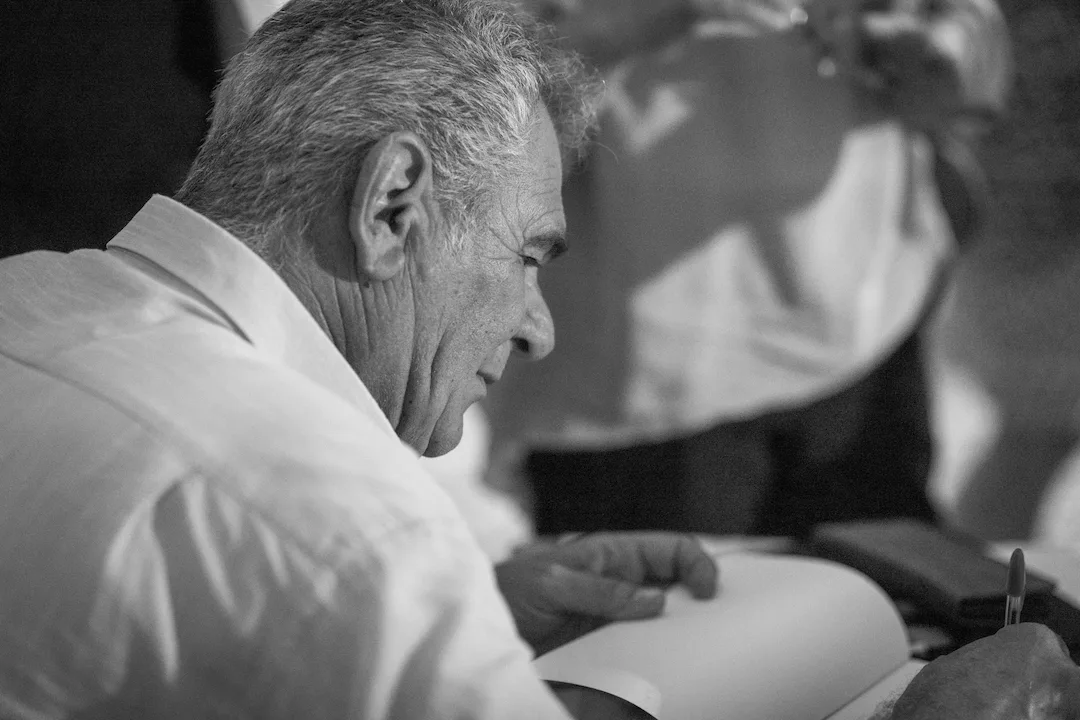
I grew up with the images and stories of World War II. All of these remained vivid and deeply etched in my mind.
I finished the six-year Gymnasium. I studied at the School of Electronic Foremen and worked at the Leros State Hospital, passing through almost all of its degraded posts. I retired as an administrative employee.
I was always curious and loved research. Life in Leros was – and still is – difficult for me, probably because of my Italian origins. Nevertheless, I feel, think, and act as a Greek, and I adore my homeland.
How did your interest in the history of Leros begin? When did you feel it became your personal mission?
It started with the conflicting historical accounts I heard in childhood and later in my teenage years. The schoolteachers, the literate people of the era, and the priests in catechism made me doubt the accuracy of what they were saying.
I consider the first good book I read – and one every person from Leros should read – to be by D. Oikonomopoulos. It is a book from 1888 titled “Leriaka: Itoi Chorographia tis Nisou Lerou”.
The second, covering more modern history, is “Events in the Aegean After the Armistice” by Aldo Levi. These two books, along with a 1688 map by Piacenza Francesco, were the first “wake-up calls” that pushed me to go out and investigate the island’s history.
There wasn’t a single moment when I suddenly decided to make this my personal mission. You read, you ask, you learn, and gradually this leads you into constant research.
Do you feel that through your work you have become a “bridge” between the old and new generations of the island?
Certainly, the ease with which young people can read, through my Facebook profile, the stories recounted by the older generations created a connection between them. I believe I acted as a link in this process.
You often speak with the island’s elderly residents. Is there a story or testimony that moved you or stayed with you?
Once, an elderly man told me a strange story: a goat fell into a well, and after a few days it appeared in the neighbor’s well!
At first it seemed funny – yet it was anything but. With that piece of information, and after extensive research, we discovered the underground Roman aqueduct of our island.


How did the local community receive your research and actions?
Acceptance is a long process. For a society to accept your work, you must prove daily through your actions that what you do is not for personal gain, but for promoting your homeland and preserving its historical heritage.
I believe that all these years I have proved exactly that, and my fellow islanders understand what kind of person I am.
Do you believe that through your work the residents have come closer to their roots and history?
I do believe they have, because someone conveyed history to them in simple Leros dialect and made them feel proud of the place where they were born.
What were the greatest difficulties you faced in trying to preserve stories, find sources, or locate monuments?
The greatest difficulty for me was the refusal of local intellectuals to give me sources that would help my research. Information was given to me piece by piece.
I received help from the Foundation Aikaterinis Laskaridi, combining what I read with what I needed to see with my own eyes.

What motivated you to write and publish the book “Tracing the History of Leros”? Was the writing process difficult?
When I started writing on Facebook, with my limited writing skills, I never imagined I would write a book.
After years, when enough texts had been gathered, Antonis Dallaris approached me and asked if I wanted to publish them as a book.
Indeed, words became action, and the book was funded by the company “Hippocrates” of the island of Kos.
What would you like readers to feel or discover through your book?
Through my book, I would like the reader to fall in love with Leros and discover that every 100 meters there is a story waiting to be told.
"Ιt is absolutely worth offering your time, money, and physical effort voluntarily for your homeland."
After your election at the Municipal Council, do you believe that your involvement in municipal matters and public affairs has changed the way people in Leros see you?
I hope and wish that my fellow islanders, who have known me my whole life, still see me simply as their friend, Franco. After all, nothing has changed for me.
Do you believe Leros has the potential to grow dynamically in historical tourism and offer visitors a meaningful experience?
I am certain that Leros has tremendous potential when it comes to historical tourism. We are talking about a living museum of World War II, on land and at sea.
As for the island’s ancient history, despite the lack of excavations by the Archaeological Service, a visit to the Archaeological Museum would convince any visitor of the island’s long-standing past.
Could some of your discoveries be presented in an organized way, made visible, or integrated into the island’s activities? Do you think this would give visitors more incentives to get to know and “feel” Leros?
I think that some of the discoveries to which my fellow islanders’ stories led me could indeed be used. The Municipality has already incorporated several of them into its program, such as the beacon towers (friktories), underground aqueducts, and caves.
After so many years of contribution and surely moments of discouragement, do you believe the volunteer’s struggle for their homeland is truly worth it?
I believe volunteer work brings joy to the person who offers it and benefits the one who receives it. So yes, it is absolutely worth offering your time, money, and physical effort voluntarily for your homeland.
What is your next step? Is there a new story or initiative you want to highlight about the history of Leros?
First of all, I hope that my next step will be the publication of my second book.
As for new actions, they arise naturally through daily life and communication with people, who always have something to tell you.
Our conversation with Franco was not only an opportunity to hear stories, but also a reminder that the history of a place is preserved only when its people are willing to serve it with humility and passion. With his second book on the horizon and his daily engagement with the island’s community, Franco continues to reveal and record Leros’ history, proving that volunteerism and a deep love for his home island can leave a lasting mark on the future of a place.