November 17 is one of the most significant dates in modern Greek history. On this day, Greece commemorates the Polytechnic Uprising (also known as the “Athens Polytechnic Rebellion”) of 1973, a student and citizen-led struggle against the military dictatorship of the colonels. At the same time, it is a day of collective memory and respect for those who fought for “Bread – Education – Freedom,” and a reminder that democracy should never be taken for granted.
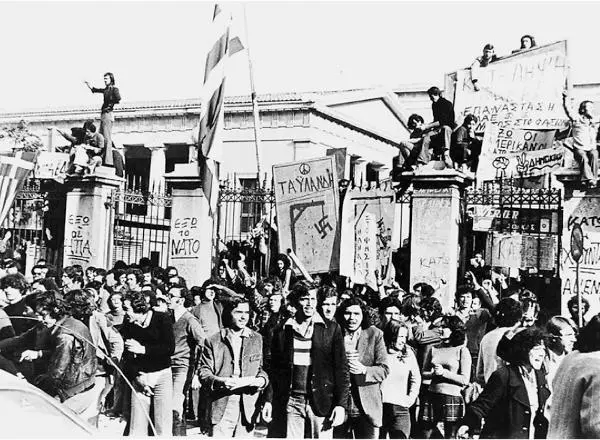
Protesters outside the Athens Polytechnic in November, 16, 1973
Protesters with with slogans and banners against the Junta
What Happened in November 1973
On November 14, 1973, students at the National Technical University of Athens (the Polytechnic) occupied the campus, initiating a protest against the regime of the Colonels’ Junta (1967–1974). By November 17, thousands of students and citizens had gathered. On the morning of the 17th, the regime launched a violent crackdown: tanks entered the Polytechnic grounds, many were injured, and several people lost their lives. Although the uprising did not immediately topple the dictatorship, it marked a turning point: it triggered a major legitimacy crisis for the regime and laid the groundwork for its fall in 1974.
The tank before it crashed through the gate of the polytechnic, and police and military storm the campus.
Why It Is Celebrated Today
November 17 has become a day of remembrance and honor for those who fought against oppression and for democracy. On this day:
Events are held across the country—memory lessons in schools, speeches, and marches.
Media outlets and social networks reflect on the importance of freedom, rights, and democratic participation.
It serves as a historical reminder that even in dark times, the voice and struggle of youth and the people can shake the political system.
The Perspective of Leros
Alongside the national historical significance of November 17, the local history of the island of Leros is also noteworthy. During the junta (1967–1974), Leros became a place of exile for dissenters, intellectuals, artists, and ordinary citizens who “did not conform to the instructions.”
“Because I did not conform to the instructions Alicarnassus, Partheni, Oropos, Korydallos The brave one awaits the light of freedom” — Mikis Theodorakis
Old Italian military installations that were used as deportation camp.
These lines, written amid oppression, reflect the fate of those exiled to the Aegean islands. Partheni on Leros became a symbol of dignity, where even under the harshest conditions, prisoners sang, painted, taught, and dreamed of freedom. In the church of Agia Kioura, the exiles decorated the interior walls and created modern, human-centered artworks, often modeling figures after fellow prisoners. The figures in these murals and icons testify to resistance and dignity during exile. Additionally, old Italian military installations in Lakki were used as deportation camps. Beyond political oppression and loss of freedom, prisoners endured extremely harsh conditions.
November 17 is not just a day on the calendar—it is a day of remembrance for the youth who dared, for the society that resisted, and for the nation that paid a heavy price to restore democracy. On Leros, this history takes on a more “local” dimension: exile, isolation, and human dignity under difficult conditions remind us that freedom was not won automatically, but through struggle.